

Bulk bathroom hardware purchases for apartment projects are less about simple volume discounts than about controlling variation across every unit. When developers are sourcing thousands of towel bars, hooks, grab bars, and other fixtures, consistent quality depends on clear product standards, qualified suppliers, finish matching, inspection protocols, and installation coordination. This article explains how developers build that consistency into the procurement process from the start, helping reduce defects, avoid costly replacements, and keep maintenance demands low after turnover. It also sets up the key decisions that shape a reliable bulk order strategy at scale.
Apartment Bathroom Hardware Bulk Order Strategy
Executing an apartment building bathroom hardware bulk order demands rigorous procurement strategies to mitigate risk and ensure uniformity across hundreds of units. For a standard 250-unit high-rise development, developers must procure upwards of 2,000 individual hardware fixtures, making supply chain efficiency and product consistency paramount. Aligning architectural vision with procurement realities requires a strategic framework that bridges upfront capital expenditure with long-term operational expenditure considerations.
Standardization Goals and Scope
Standardization minimizes long-term maintenance overhead and accelerates the installation timeline for general contractors. By restricting the scope of hardware to a unified design language and a single trusted manufacturer, developers can achieve significant economies of scale and virtually eliminate the risk of mismatched finish tolerances across different unit layouts. A robust standardization strategy typically targets a defect rate of less than 0.5% across the entire procurement cycle. Achieving this specific metric ensures that property management teams are not burdened with premature replacements or tenant complaints during the critical initial lease-up phase, thereby protecting the asset’s net operating income.
Product Categories and Performance Requirements
The primary product scope within these bulk orders typically encompasses towel bars, toilet paper dispensers, robe hooks, shower curtain rods, and critical ADA-compliant grab bars. Performance requirements must be explicitly defined in the procurement documentation rather than relying on generic catalog specifications. For instance, commercial-grade grab bars must strictly meet or exceed the ADA requirement of a 250-pound structural pull load when properly blocked and mounted. Furthermore, moving components, such as pivoting tissue holders or retractable lines, should be mechanically rated for a minimum of 50,000 operational cycles. Establishing these baseline performance metrics ensures the hardware withstands the high-turnover, high-use realities of modern multifamily environments.
Specifications and Supplier Controls
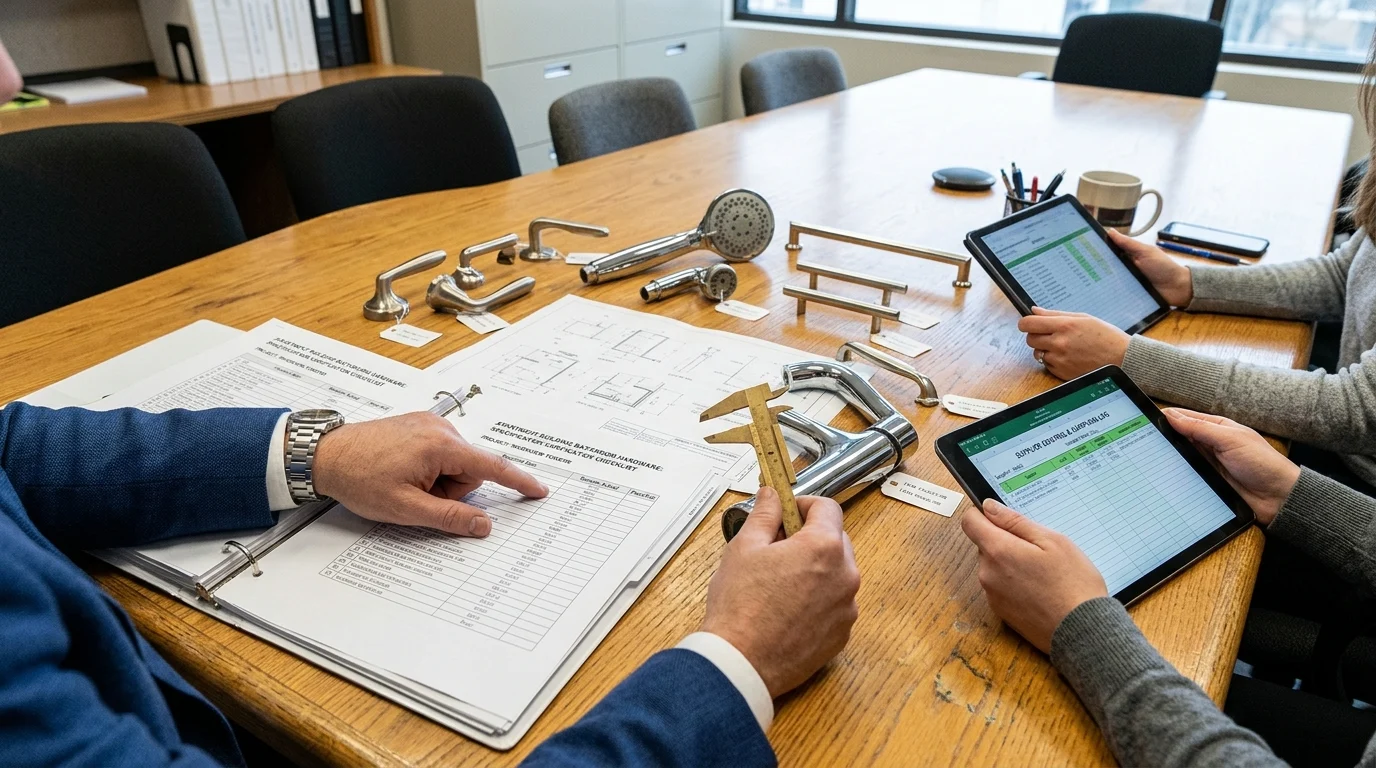
Transitioning from high-level strategy to exact manufacturing specifications requires stringent supplier controls. Developers must mandate specific metallurgical compositions and finish durability standards to prevent premature oxidation, blistering, or mechanical failure in high-humidity, poorly ventilated bathroom environments. Relying on visual approximations is insufficient; empirical testing data is mandatory to secure the investment.
Materials, Finishes, and Load Ratings
Material selection dictates both the expected lifecycle and the unit cost of the hardware suite. Premium developments typically specify Type 304 stainless steel for its superior corrosion resistance and structural rigidity, while mid-market or value-engineered projects may utilize zinc die-cast alloys finished with specialized plating. Finishes must undergo rigorous testing to verify environmental resilience. For example, a standard requirement for bathroom hardware is passing a 96-hour neutral salt spray test without showing signs of red rust or pitting. Modern developers are also increasingly specifying Physical Vapor Deposition (PVD) finishes over traditional electroplating, as PVD offers superior scratch resistance and color fastness over a 10-year horizon.
| Material Base | Typical Application | Corrosion Resistance | Relative Cost Index |
|---|---|---|---|
| Type 304 Stainless Steel | Luxury / High-Moisture | Excellent | 1.5x |
| Zinc Die-Cast Alloy | Mid-Market | Moderate to Good | 1.0x (Baseline) |
| Extruded Aluminum | Modern / Lightweight | Good | 1.2x |
| Chrome-Plated Brass | Premium / Traditional | Excellent | 2.0x |
Comparison Criteria and Decision Support
Evaluating potential manufacturing partners requires analyzing their production capacity, quality management systems, and commercial flexibility. Sophisticated developers prioritize suppliers holding active ISO 9001 certifications and demonstrating a monthly production capacity exceeding 10,000 units to avoid critical path bottlenecks. Furthermore, negotiating Minimum Order Quantities (MOQs) is a crucial commercial lever during the bidding phase. Securing Tier 1 bulk pricing typically requires an MOQ threshold of 500 to 1,000 units per individual SKU, depending on the complexity of the custom finish. Procurement teams utilize weighted decision matrices that score suppliers on a combination of historical defect rates, raw material indexing transparency, and available warranty durations.
Sourcing, Quality Assurance, and Delivery

The final phase of a bulk hardware order encompasses rigorous quality assurance protocols and complex logistics management. Coordinating international freight, customs clearance, and site-specific delivery windows generally requires a macro lead time of 90 to 120 days from the issuance of the final purchase order to the arrival of goods on site.
Sampling, Production, and Inspection Process
Quality control begins at the factory level with the First Article Inspection (FAI), where initial production run samples are verified against the approved design blueprints, dimensional tolerances, and master finish swatches. Following the commencement of mass production, developers or their third-party quality assurance proxies implement strict Acceptable Quality Limit (AQL) inspections. A standard threshold for architectural bathroom hardware is AQL 1.5 for major defects, such as deep surface scratches or structural mounting flaws, and AQL 4.0 for minor defects, such as slight packaging damage or microscopic finish inconsistencies. Shipments are only authorized for export once these statistical sampling thresholds are successfully met and documented.
Final Selection and Trade-Off Framework
Procurement teams must continuously balance aggressive unit costs against logistical reliability and inventory carrying costs. Opting for direct-to-site container shipping offers the lowest per-unit cost but carries high vulnerability to port delays and requires substantial on-site storage capacity. Conversely, utilizing a supplier with a domestic warehousing and distribution program may incur a 10% to 15% unit price premium but guarantees staggered delivery schedules perfectly aligned with active construction phases. Developers frequently employ a phased delivery model—shipping 30% of the volume for early rough-in requirements and holding the remaining 70% for final trim-out. This trade-off framework optimizes on-site storage limitations, improves cash flow, and significantly reduces the risk of material theft or damage during the chaotic dry-in phases of construction.
Key Takeaways
- The most important conclusions and rationale for Apartment Building Bathroom Hardware Bulk Order: How Developers Ensure Consistent Quality
- Specs, compliance, and risk checks worth validating before you commit
- Practical next steps and caveats readers can apply immediately
Frequently Asked Questions
What bathroom hardware should developers standardize in a bulk order?
Focus on towel bars, toilet paper holders, robe hooks, shower rods, and ADA grab bars. Keeping one style and finish across units reduces mismatches, speeds installation, and simplifies future maintenance.
Which materials work best for apartment bathroom hardware?
Type 304 stainless steel offers the best corrosion resistance for humid bathrooms. Zinc die-cast hardware is a cost-effective option when paired with durable plating or PVD finishes.
How can buyers verify consistent quality from a hardware supplier?
Ask for ISO 9001 certification, salt spray test reports, load ratings, and cycle test data. Also require approved pre-production samples and third-party inspections before shipment.
What performance specs matter most for multifamily bathroom hardware?
Grab bars should meet a 250-pound pull load when properly installed. Moving parts like tissue holders should be rated for about 50,000 cycles, and finishes should pass a 96-hour neutral salt spray test.
How can HZ Die Casting support apartment bathroom hardware bulk orders?
HZ Die Casting can help with zinc die-cast manufacturing, finish consistency, sample approval, and scalable production for large apartment projects. Confirm MOQ, lead time, inspection process, and finish test standards before ordering.