

Introduction
As 2026 compliance deadlines approach, bathroom hardware makers face tighter rules on material safety, water-contact performance, and traceability across major markets. CUPC, CE, and WaterMark are each raising technical expectations in ways that affect alloy selection, sealing materials, testing, and certification planning. This overview explains what is changing, why the revisions matter for North American, European, and Australasian access, and how manufacturers can adapt product design and documentation to avoid delays, rework, and market entry risks.
Why 2026 Global Bathroom Hardware Access Standards Matter
The regulatory landscape for sanitary ware is undergoing a rigorous transformation as the 2026 global bathroom hardware access standards approach implementation. Manufacturers and distributors must navigate a complex matrix of updated technical criteria to secure market entry in North America, Europe, and Australasia. These eminent shifts represent more than routine administrative updates; they mandate fundamental reengineering of metallurgy, fluid dynamics, and supply chain transparency.
What changed in CUPC, CE, and WaterMark technical expectations
The 2026 revisions to major certification frameworks introduce stringent environmental and material safety thresholds. Under the CUPC framework, enforcement of NSF/ANSI 372 further tightens the acceptable weighted average lead content, pushing manufacturers toward advanced lead-free brass alloys or stainless steel alternatives. Simultaneously, European CE marking protocols under the Construction Products Regulation (CPR) are integrating stricter PFAS (per- and polyfluoroalkyl substances) restrictions for internal seals and lubricants. In the Australasian market, the WaterMark certification scheme is finalizing its transition to mandate dezincification-resistant (DZR) materials with a strict 0.1% maximum lead threshold for all potable water contact components.
How compliance affects pricing, launch timing, and market access
These regulatory enhancements directly impact production economics and time-to-market. Certification expenditures are projected to increase, with comprehensive testing for a new product family under combined CUPC and WaterMark standards now commanding between $8,000 and $15,000. Furthermore, laboratory bottlenecks are extending lead times; manufacturers must now allocate 12 to 16 weeks for initial compliance testing, up from the historical 8-week average. Failure to proactively align product development with these 2026 expectations risks sudden market exclusion, stranded inventory, and severe disruptions to global launch schedules.
Latest Technical Requirements for CUPC, CE, and WaterMark
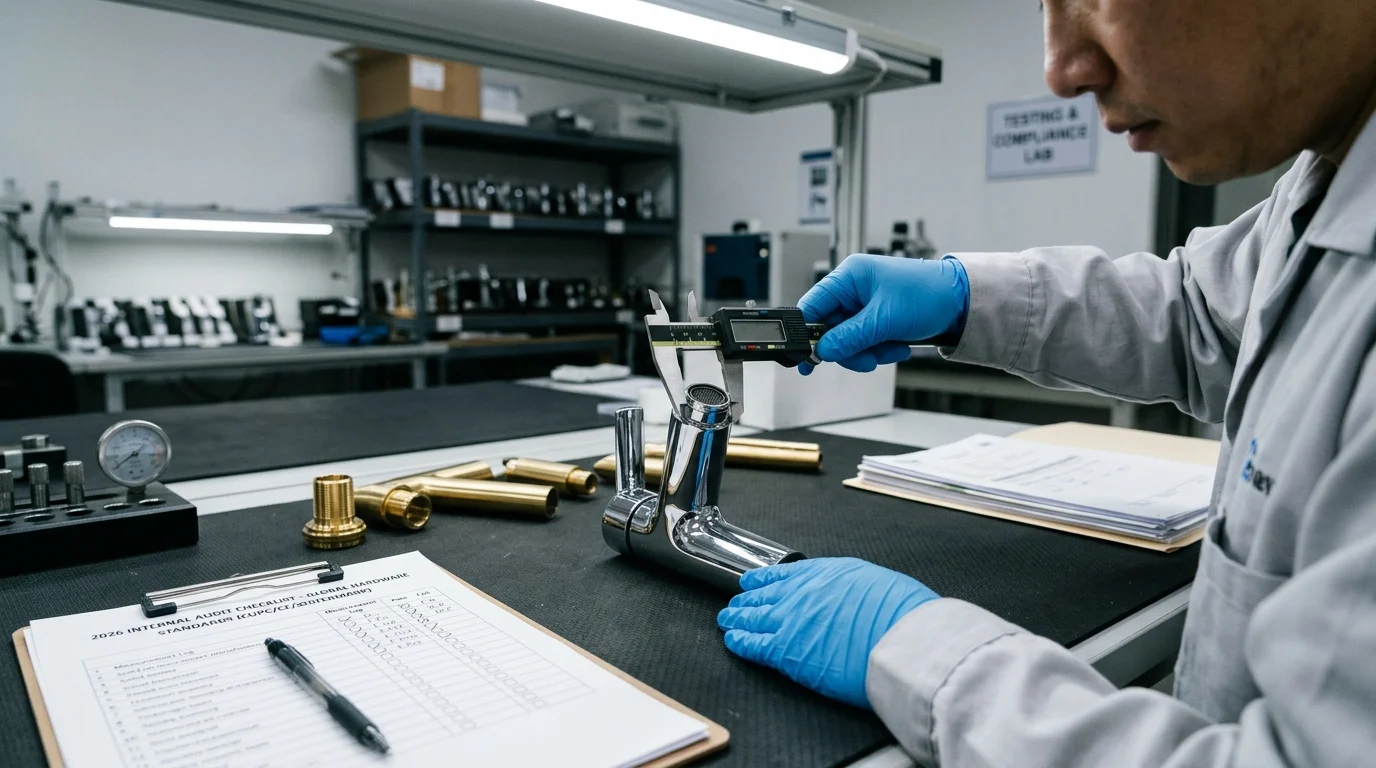
To maintain uninterrupted market access, manufacturers must engineer products that satisfy highly specific performance and safety metrics. The 2026 iterations of CUPC, CE, and WaterMark demand rigorous validation across both physical durability and chemical leaching parameters, leaving no margin for sub-standard component sourcing.
Product performance, material, and safety specifications
Product performance specifications are becoming increasingly unforgiving. For CUPC compliance (governed largely by ASME A112.18.1/CSA B125.1), pressure-balancing valves must withstand burst pressure testing at 500 PSI without structural failure while maintaining flow rates strictly below 1.2 GPM to meet concurrent EPA WaterSense mandates. European CE standards (EN 817 for mechanical mixers) require rigorous acoustic testing to maintain noise classifications below 20 decibels at 3 bar pressure, alongside lifecycle testing of 70,000 cycles for ceramic cartridges. Meanwhile, WaterMark (AS/NZS 3718) places heavy emphasis on hydrostatic strength and the structural integrity of DZR brass alloys under high-temperature, high-chloride water conditions.
Testing, documentation, traceability, and factory controls
Beyond physical testing, the 2026 frameworks demand unprecedented documentation and factory control mechanisms. Certification bodies now require comprehensive ISO 9001 integration linked directly to product traceability. Manufacturers must implement lot-level tracking, often utilizing mandatory QR codes or laser-etched batch numbers on the hardware body, to ensure immediate recall capabilities. Factory audits are increasing in frequency, transitioning to an unannounced format in several jurisdictions. To maintain an active certification status, facilities must demonstrate statistical process controls that keep critical defect rates below a stringent 0.1% threshold, accompanied by quarterly third-party material spectroanalysis reports.
How to Compare and Manage CUPC, CE, and WaterMark Compliance

Managing multi-region compliance requires strategic alignment of engineering, procurement, and quality assurance resources. Instead of treating each standard as an isolated hurdle, industry leaders synthesize these requirements into a unified product architecture that satisfies the highest common denominator.
Key comparison points for a technical table
A comparative analysis of the primary frameworks reveals distinct regional priorities that dictate engineering decisions. Understanding these overlapping yet distinct criteria is essential for developing a globally viable product line.
| Standard | Target Region | Key Material Focus | Minimum Lifecycle Requirement | Primary Flow Rate Limit |
|---|---|---|---|---|
| CUPC | North America | <0.25% Lead (NSF 372) | 500,000 cycles (valves) | ≤1.2 GPM (EPA WaterSense) |
| CE (EN 817) | Europe | REACH/PFAS Compliance | 70,000 cycles (cartridges) | Eco-design directive tiers |
| WaterMark | Australia/NZ | DZR Brass, <0.1% Lead | 50,000 cycles (mixers) | WELS 6-star (4.5 L/min) |
Practical steps to reduce nonconformance risk across markets
To mitigate nonconformance risks across these diverse markets, manufacturers should adopt a centralized Bill of Materials (BOM) strategy. Specifying pre-certified internal components—such as ceramic cartridges and aerators that already hold dual or triple certifications—drastically reduces internal testing failures. Procurement teams must also negotiate strategic minimum order quantities (MOQs) for compliant raw materials; for instance, securing high-grade DZR brass typically requires an MOQ of 2 to 3 tons per batch to maintain cost efficiency. Finally, implementing automated inline pressure testing at 100% of assembly stations, rather than relying on randomized batch sampling, ensures that every unit leaving the facility meets the strict 2026 hydrostatic expectations of global regulators.
Key Takeaways
- The most important conclusions and rationale for 2026 Global Bathroom Hardware Access Standards: Latest Technical Requirements of CUPC, CE, and WaterMark
- Specs, compliance, and risk checks worth validating before you commit
- Practical next steps and caveats readers can apply immediately
Frequently Asked Questions
What are the main 2026 changes in CUPC, CE, and WaterMark standards?
They tighten lead limits, add stricter PFAS controls, and require more durable materials and testing. CUPC focuses on lower lead content, CE adds stronger chemical compliance, and WaterMark pushes DZR materials with a 0.1% lead maximum.
Which materials are best for 2026-compliant bathroom hardware?
Lead-free brass, stainless steel, and DZR brass are the safest choices. For seals and lubricants, use PFAS-compliant alternatives to reduce EU compliance risk.
What product tests are now required for market access?
Expect burst, hydrostatic, flow-rate, acoustic, and cycle-life testing. Examples include 500 PSI burst for CUPC valves, under-20 dB noise for CE mixers, and durability validation for WaterMark.
How long does 2026 certification testing usually take?
Plan for 12 to 16 weeks for initial testing. Multi-standard projects often take longer if material changes or retesting is needed.
How can manufacturers reduce nonconformance risk?
Use lot-level traceability, batch marking, ISO 9001 controls, and quarterly material testing. For die-cast bathroom hardware, tighter sourcing and in-process QC are essential.